Search
Pharmaceutical Science MSci/BSc (Hons) with foundation year
Study level: UndergraduateDegree with foundation year

Develop practical and theoretical expertise in drug design, molecular modelling, analytical techniques and biopharmaceutical production, with opportunities for hands-on experience throughout the course.
Course features
Course option
Year of entry
Location
CU Coventry (Coventry) and
Coventry University (Coventry)
Study mode
Full-time
Sandwich
Duration
BSc:4 years full-time5 years sandwich
UCAS codes
B1DF
Start date
September 2026
November 2026
January 2027
March 2027
May 2027
July 2027
Course overview
Our degree with foundation year could be the stepping stone you need to achieve your goals. The foundation year aims to prepare you for degree-level study and is a great way to build the confidence, skills and knowledge needed to succeed on your degree course.
Foundation Year
The foundation year course helps you develop the necessary skills for degree-level study. In addition, you will also explore fundamental knowledge in areas such as anatomy, physiology and pathology, professional practice and approaches to health and wellbeing.
Degree
Develop knowledge and skills relevant to drug discovery, design and development, pharmacology, pharmaceutics and drug regulatory affairs. This course is designed for those with a strong interest in chemistry, biology and the development of new medicines.
- Examine the science behind drug discovery and development and develop scientific knowledge and practical skills.
- Explore molecular modelling, drug design, advanced analytics and biopharmaceutical production.
- Opportunities for hands-on lab experience and studying real-world applications should help prepare you to address global health challenges.4

Rated Gold Overall
Teaching Excellence Framework (TEF) 2023
5 QS Stars for Teaching and Facilities
QS Stars University Ratings
Top 5 Student City in England (Coventry)
QS Best Student Cities Index 2026Why you should study this course
Foundation Year
Gain the academic skills required for degree-level study and develop knowledge of anatomy, physiology, health and wellbeing.
Degree
- Develop hands-on skills in labs: gain practical, in-demand skills by working with the latest pharmaceutical technology in our advanced labs, ensuring you're not just learning theory but also mastering the techniques that drive modern drug development.4
- Industry-relevant curriculum and career prospects: study a course that is designed in collaboration with leading pharmaceutical companies, and graduate with the knowledge and skills needed to launch a successful career in a rapidly expanding field.
- Focus on emerging and globally relevant pharmaceutical science: learn how to address health challenges by studying areas, such as personalised medicine and antimicrobial resistance.
- Dive deep into pharmaceutical science with our MSci year: You may choose to extend your studies with the MSci route (subject to meeting progression requirements). Develop the expertise to design and synthesise the next generation of medicines, master the complexities of biopharmaceutical production, understand the intricate interactions of drug metabolism and toxicology and explore the role of natural products in drug discovery.
What you'll study
In your foundation year, you’ll study how the body works, what happens when it goes wrong and how lifestyle affects health. Explore professional standards, public health and strategies to promote wellbeing in individuals and communities.
Develop scientific knowledge and technical skills to prepare for roles in pharmaceuticals, biotechnology or healthcare. Study how medicines interact with the human body, explore drug discovery methods, and develop expertise in pharmacology, medicinal chemistry, pharmaceutics and computational biology. Learn through hands-on experience with modern techniques like qPCR, flow cytometry and tableting while using simulation spaces and bioinformatics tools. The integrated MSci year is designed to help you deepen your knowledge and learn how to design the next generation of medicines (subject to meeting progression requirements).
We regularly review our course content, to make it relevant and current for the benefit of our students. For these reasons, course modules may be updated.
How you'll learn
Entry requirements
Typical entry requirements:
Got higher grades? Have you considered direct entry to the degree without foundation year?
Fees and funding
Foundation year
| Student | Full-time | Part-time |
|---|---|---|
| UK, Ireland*, Channel Islands or Isle of Man | £9,790 | Not available |
| International/EU | Not currently available*** | Not available |
Degree
| Student | Full-time | Part-time |
|---|---|---|
| UK, Ireland*, Channel Islands or Isle of Man | £9,790 per year | Not available |
| International/EU | Not currently available*** | Not available |
If you choose to study this course with a professional placement2 or study abroad year, you will need to pay a tuition fee3 to cover your academic support throughout your placement year. Students commencing their professional placement in the academic year 2028/29 will pay £1,575 if they are paying UK fees, or £1,900 if they are paying international fees.
For advice and guidance on tuition fees and student loans visit our undergraduate finance page and see the university’s Tuition Fee and Refund Terms and Conditions.
The University will charge the tuition fees that are stated in the above table for the first Academic Year of study. The University will review tuition fees each year. For UK (home) students, if Parliament permits an increase in tuition fees, the university may increase fees for each subsequent year of study in line with any such changes. Note that any increase is expected to be in line with inflation.
If you choose to study this course with a professional placement, the University will charge the tuition fees stated above for those on a placement during Academic Year 2028/29. The University will review professional placement tuition fees each year. For UK (home) students, the University may increase fees for each subsequent year of study, but such that it will be no more than 5% above inflation.
Tuition fees cover the cost of your teaching, assessments, facilities and support services. There may be additional costs not covered by this fee such as accommodation and living costs, recommended reading books, stationery, printing and re-assessments should you need them. Find out what's included in your tuition costs.
Applies to degree only
The following are additional costs not included in the tuition fees:
- Any optional overseas field trips or visits: £400+ per trip.
- Any costs associated with securing, attending or completing a placement (whether in the UK or abroad).
Foundation year funding
In order to receive funding for degree with foundation year courses, you will need to complete a four-year degree programme which includes the integrated foundation year, otherwise you may be responsible for your foundation year fees. For further information, please refer to the 'Tuition Fee Loan' details in the 'Funding your undergraduate course' section of our 'Fees and finance' page.
*Irish student fees
The rights of Irish residents to study in the UK are preserved under the Common Travel Area arrangement. If you are an Irish student and meet the residency criteria, you can study in England, pay the same level of tuition fees as English students and utilise the Tuition Fee Loan.
**This course with foundation year is not currently available to international students.
How do you know if you need to pay UK or international tuition fees?
Facilities
Our foundation years are taught at CU Coventry’s Mile Lane building, a short walk from the city centre. You’re part of the university from day one, so during your foundation year you’ll have access to the wider facilities at Coventry University. Once you successfully complete your foundation year, you'll transfer over to studying your chosen degree at Coventry University, where you'll be taught on campus in the relevant academic buildings.
Located on our Mile Lane campus, you will have access to our Library and Learning Services (LLS), fully equipped seminar rooms and IT suites4. You can also take advantage of reading rights in Coventry University’s Lanchester Library, make use of sport centre facilities and receive full membership to Your Students' Union.
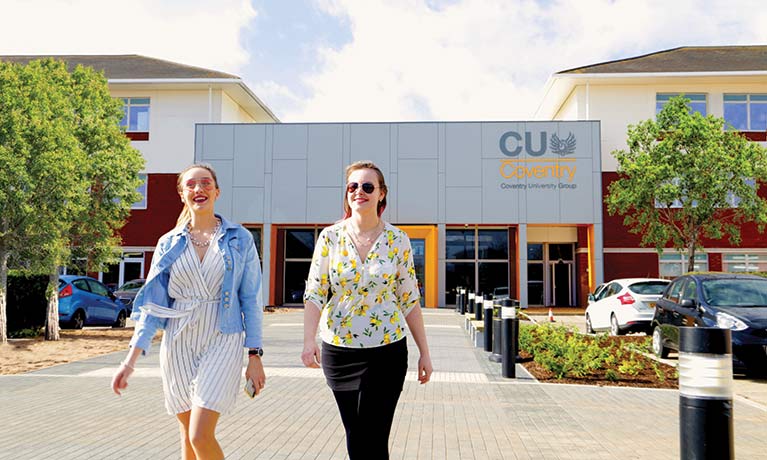
Mile Lane
The campus is home to an on-site library with bookable one-to-one academic writing service and library support sessions, fully equipped seminar rooms, open-access study areas, a café and an IT suite. Our labs contain industry-standard equipment so that you learn using the same equipment as many industry professionals.

The Hub
At The Hub you'll find the Health and Wellbeing Centre, the Students’ Union and Square One (which provides entertainment from quiz nights to live music), the Spirituality and Faith Centre, Tank Studio, Careers Office and a fantastic food court.

Lanchester Library
Coventry University’s Lanchester Library is usually open 364 days a year, and has 1,400 study spaces, including group and silent areas. It also currently offers more than 550 computers and an additional 120 free-to-loan laptops.
Facilities are subject to availability. Access to some facilities (including some teaching and learning spaces) may vary from those advertised and/or may have reduced availability or restrictions where the university is following public authority guidance, decisions or orders.
The degree will be predominantly taught in the Alison Gingell Building on the Coventry University main campus. It is home to microbiology, cell culture, molecular biology/genetics and analytical chemistry laboratories, allowing you to work in a professional environment.4

SuperLab
Our SuperLab has facilities for cell culture and equipment for microscopy, DNA, RNA and protein analysis.

Analytical Chemistry Suite
Apply your practical and theoretical knowledge to real-life working scenarios and get the opportunity to use new generation chromatography techniques to analyse products ranging from pharmaceutical agents to cosmetics, drinks and toxins.

Physiology Suite
separate physiology and health laboratory facilities enable the measurement of physiological parameters such as heart rate, blood pressure, lung function test and neuromuscular functioning.
Facilities are subject to availability. Access to some facilities (including some teaching and learning spaces) may vary from those advertised and/or may have reduced availability or restrictions where the university is following public authority guidance, decisions or orders.
Careers and opportunities
Graduates with this degree have a wide range of career options available to them in pharmaceutical, chemistry, biotechnology and healthcare-based industries. This may include drug discovery, design and development, pharmacology, pharmaceutics, and drug regulatory affairs.
Specific roles may include:
- Pharmaceutical Scientist
- Research Scientist
- Clinical Trials Assistants
- Medical/Pharmaceutical Sales Representative
- Product Development Technologist
- Drug Safety Associate
- Quality Control Analyst
- Medical Science Liaison
- Pharmacy Technician
- Post graduate study
- Teaching
The graduate destinations listed above illustrate potential career paths. You may need to gain additional qualifications or practical experience, pass professional examinations, complete training, cover associated costs and meet specific visa or immigration requirements to secure employment in these fields.

Discover Phoenix+
Phoenix+ brings you together with other students to learn, experience and develop essential knowledge and skills. Whatever destination you choose, it's about preparing you for life after university.
Learn more about Phoenix+How to apply
This course with foundation year is not available to international students.
UK students
Disclaimers
You may also like

Coventry University (Coventry)

Pharmacology BSc (Hons)
Coventry University (Coventry)

Biomedical Science BSc (Hons)
Coventry University (Coventry)